share
GENERAL
Core Cutting in Modern Construction: A Practical Guide for Builders and Contractors
June 26, 2026
6 Views
Introduction
Every contractor eventually runs into a wall, slab, or column that needs a clean, precise opening — for a pipe, a duct, an electrical conduit, or a structural inspection. That's where core cutting comes in. It's one of those construction techniques that rarely gets discussed in detail, yet it quietly holds together a huge share of plumbing, HVAC, electrical, and retrofit work across India.
This guide breaks down what core cutting actually involves, the equipment and methods used, where it fits into a project timeline, and how to choose a contractor who won't leave you with cracked tiles or a compromised structure.
What Is Core Cutting?
Core cutting is the process of drilling or cutting a precise, round or rectangular opening through concrete, masonry, or RCC (Reinforced Cement Concrete) structures. Unlike demolition, which breaks material apart, core cutting removes a clean section — a "core" — leaving smooth edges and minimal disturbance to the surrounding structure.
It's most commonly used for:
- Passing pipes, cables, and ducts through walls, slabs, or floors
- Installing exhaust fans, AC units, or ventilation systems
- Creating access points for plumbing and electrical retrofits
- Structural testing (extracting concrete cores for lab analysis)
- Modifying existing buildings during renovation
The term concrete core cutting is often used interchangeably with core cutting, since concrete and RCC are the most common materials involved. When the cut goes through a load-bearing wall or slab with embedded steel reinforcement, it's typically called RCC core cutting, and it demands extra caution to avoid weakening the structure.
How Core Cutting Works
The Diamond Core Drilling Method
The most widely used technique today is diamond core cutting, performed using a diamond-tipped hollow drill bit attached to a rotary machine. The diamond segments on the bit grind through concrete and steel reinforcement with water cooling to control dust and heat.
Here's a simplified breakdown of the process:
- Marking and measurement — The exact location, depth, and diameter are marked based on architectural or MEP drawings.
- Setting up the rig — A core drilling machine is anchored to the surface using a base plate and vacuum or bolt fixing.
- Drilling — The diamond core bit rotates and advances through the material, often with water flow to reduce friction and dust.
- Core extraction — The cut cylindrical core is removed, leaving a clean circular opening.
- Finishing — Edges are checked, and if needed, sealed or reinforced depending on the application.
This method is preferred for slab cutting, wall cutting, and column penetrations because it's precise, low-vibration, and doesn't generate the kind of structural shock that hammering or chiseling would.
Diamond Core Cutting vs. Traditional Methods
| Factor |
Diamond Core Cutting |
Traditional Hammering/Chiseling |
| Precision |
High — clean, exact diameter |
Low — irregular, rough edges |
| Vibration impact |
Minimal |
High, risk to nearby structure |
| Dust and noise |
Low (water-cooled) |
High |
| Speed |
Fast for standard diameters |
Slow and labor-intensive |
| Suitability for RCC |
Safe with proper technique |
Risk of rebar damage |
| Finish quality |
Smooth, ready for fitting |
Requires patching |
For any project involving reinforced concrete, diamond-based core drilling is now the industry standard, especially in urban India where buildings are densely constructed and structural sensitivity is high.
Common Applications of Core Cutting
Residential Projects
Homeowners typically need core cutting for exhaust fan installations, AC pipe routing, geyser ducting, or plumbing line replacements. A clean cut avoids unnecessary damage to tiles, flooring, or finished walls.
Commercial and Industrial Projects
Office buildings, malls, and factories often require larger-diameter cuts for HVAC ducting, fire safety systems, or cable trays. These projects demand coordination with structural engineers, since commercial slabs carry heavier loads.
Infrastructure and Retrofitting
Bridges, flyovers, and old buildings undergoing renovation frequently need construction cutting services for structural assessment — engineers extract core samples to test concrete strength, carbonation depth, or chloride content.
Wall Cutting and Slab Cutting: Key Differences
While core cutting refers to circular openings, wall cutting and slab cutting often involve straight-line cuts using wall saws or floor saws, typically for:
- Creating doorways or window openings in existing walls
- Cutting expansion joints in slabs
- Removing sections of flooring for utility access
- Demolishing partial wall sections without affecting adjoining structure
Both wall cutting and core cutting fall under the broader umbrella of concrete cutting, but the tools and techniques differ. Wall and floor saws use diamond blades for linear cuts, while core drills are designed specifically for round penetrations.
Factors That Affect Core Cutting Cost and Complexity
Several variables influence how a project is priced and planned:
- Diameter of the cut — Larger diameters need more powerful machines and take longer.
- Material thickness — A 9-inch RCC slab takes longer to cut than a 4-inch partition wall.
- Reinforcement density — Heavily reinforced columns or shear walls require slower, more careful drilling.
- Location and access — Cutting on upper floors or tight spaces increases labor and equipment costs.
- Number of cuts — Bulk requirements (e.g., multiple AC duct openings across a building) often get better per-unit pricing.
- Water and dust management — Indoor cutting near finished interiors may need vacuum-based dust control instead of wet cutting.
A reliable approach is to get a site assessment before finalizing scope, since drawings don't always reflect actual on-site conditions like hidden rebar or utility lines.
Safety and Structural Considerations
Core cutting through load-bearing elements isn't something to take lightly. A poorly planned cut through a structural column or beam can compromise the building's integrity. Before any RCC core cutting work begins, experienced contractors typically:
- Use rebar detectors to map embedded steel before drilling
- Consult structural drawings to confirm the element isn't load-critical
- Limit cut diameters to avoid excessive section loss
- Apply reinforcement (like steel collars) around large openings when required
This is one reason why core cutting, despite looking like a simple drilling job, is best handled by teams with structural awareness rather than general labor crews. One of the patterns seen across well-managed projects — including work coordinated through Core Cutting Services providers covering contractor networks across Indian cities — is that pre-drilling structural checks consistently reduce rework and post-cutting repair costs.
Choosing the Right Core Cutting Contractor
When evaluating a contractor or service provider, consider:
- Equipment quality — Are they using diamond core drills with water-cooling, or outdated rigs?
- Experience with RCC — Have they worked on reinforced structures, not just brick walls?
- Safety protocols — Do they check for rebar and utilities before cutting?
- Portfolio and reviews — Can they show past project photos or client feedback?
- City-specific availability — Especially relevant in India, where service quality varies significantly between metro and tier-2 cities.
A well-coordinated contractor will also handle debris removal, dust control, and minor finishing — not just the cut itself.
Frequently Asked Questions
1. What is the standard diameter range for core cutting? Core cutting diameters typically range from 25mm (1 inch) for small cable openings to 300mm (12 inches) or more for HVAC ducting and large utility penetrations.
2. Is core cutting safe for load-bearing walls? It can be, but only when done by experienced professionals who check reinforcement placement and structural drawings beforehand. Cutting through load-bearing elements without assessment carries real risk.
3. How long does a typical core cutting job take? A standard 4-6 inch cut through a residential wall usually takes 15-30 minutes per hole, depending on material thickness and reinforcement. Larger or multiple cuts take proportionally longer.
4. What's the difference between core cutting and core drilling? The terms are largely interchangeable in the construction industry — both refer to creating circular openings using diamond-tipped rotary equipment, though "core drilling" is sometimes used specifically for vertical, downward cuts.
5. Can core cutting be done indoors without major mess? Yes. Many contractors now offer dust-extraction or vacuum-based core cutting for indoor and finished spaces, minimizing water use and debris compared to traditional wet cutting.
Conclusion
Core cutting might seem like a minor technical detail in a construction project, but it plays a meaningful role in how cleanly and safely a building accommodates plumbing, electrical, and HVAC systems over its lifetime. Whether you're a homeowner installing an AC unit or a contractor managing a commercial retrofit, understanding the basics — diameter selection, material considerations, structural safety, and contractor vetting — helps you avoid costly mistakes. As more Indian cities densify and renovate older infrastructure, demand for skilled, safety-conscious core cutting professionals will only continue to grow.
share Share now

 All Services
 Service Experts
 IT Service
 Explore Travel
 Gym
Gym Products
 Vouchers & Deals
 Blogs
Blogs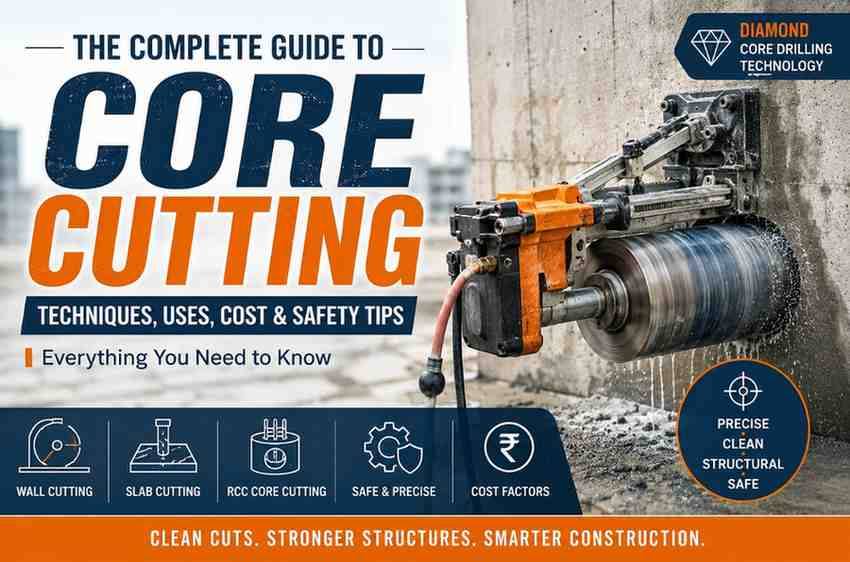



 Hotels
 Spa
Spa Support